
Research
Unanticipated technologies can blossom from seemingly unrelated developments. Solid state quantum theory gave us the transistor. Video games drove the modern economics of GPU production. DNA sequencing, originally developed to map the genes of humans and other organisms, has become a mainstay of biological measurement across naturally occurring genetic diversity and engineered systems. Our laboratory takes this still further through the development of DNA microscopy.
DNA microscopy starts from a statistical premise: biomolecules can be assigned unique DNA identities, and chemical reactions can link those identities in a way that is biased by the original molecules' proximities. The resulting DNA network encodes enough local information that computation can, in effect, "rewind the tape" to infer spatial structure.
In this sense, DNA microscopy treats chemistry as an information processing system. The original planar work established this premise in 2D. Current work extends it to 3D spatial transcriptomics at the scale of whole organisms and to dense network measurements in intact tissue.
Volumetric DNA Microscopy (VDM)
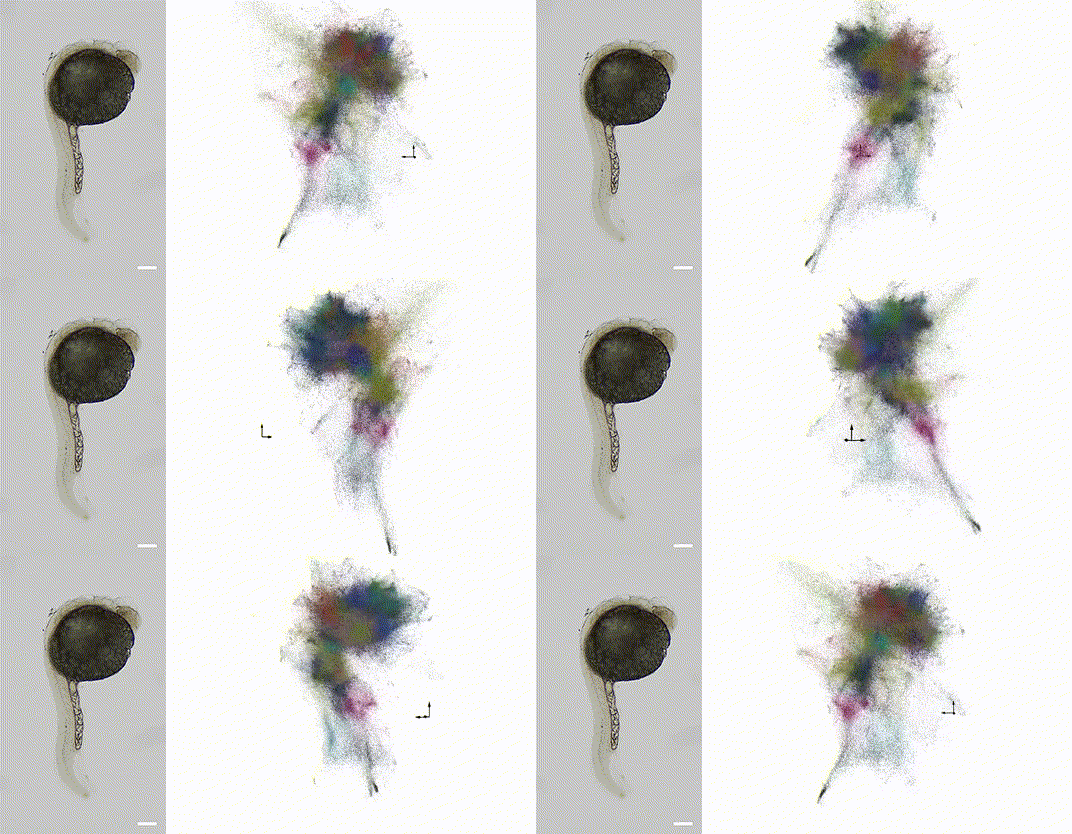
Our 2025 work in Nature Biotechnology introduces volumetric DNA microscopy, which captures 3D spatial transcriptomic information from intact specimens. The method establishes a distributed network of DNA barcodes throughout the specimen, with molecular proximities encoded through controlled biochemical reactions spanning multiple length scales -- anchored rolling circle amplification for interactions over short distances (~1 μm) and in vitro transcription for diffusion over longer distances (~10 to 50 μm).
The approach uses geodesic spectral embedding algorithms to infer 3D coordinates from the resulting proximity networks, achieving theoretical median resolution of approximately 1.5 μm, conditionalized on local UMI density. This enables spatial transcriptomics at the scale of whole organisms without prior knowledge of genome organization or spatial templates.
Crosslinked Volumetric DNA Microscopy (xVDM)
Our 2026 bioRxiv preprint extends volumetric DNA microscopy with crosslinked molecular networks for dense phenotyping in intact tissue. This work moves the platform from mapping transcript positions alone toward richer network measurements across tissue, embryos and specimens.
Selected Publications
- Qian, N., Yasser, R., Yu, M., Chang, H., Weinstein, J.A. "Cross-linked volumetric DNA microscopy for dense molecular-network phenotyping in intact tissue." bioRxiv (2026). (preprint)
- Qian, N., Li, J., Yasser, R., Yu, M., Weinstein, J.A. "Volumetric DNA microscopy for mapping spatial transcriptomes in three dimensions." Nature Protocols (2026). (paper)
- Yasser, R., Yu, M., Qian, N., Chang, H., Weinstein, J.A. "Connectogenomics: edges-first spatial biology." Trends Biotechnol (2025). (review)
- Qian, N., Weinstein, J.A. "Spatial transcriptomic imaging of an intact organism using volumetric DNA microscopy." Nat Biotechnol (2025). (paper, preprint)
- Weinstein JA, Regev A, Zhang F. "DNA microscopy: Optics-free spatio-genetic imaging by a stand-alone chemical reaction." Cell. 2019 Jun 27. (paper, preprint)
- Vollmers C, Sit RV, Weinstein JA, Dekker CL, Quake SR. "Genetic measurement of memory B-cell recall using antibody repertoire sequencing." Proc Natl Acad Sci USA. 2013 Jul 29. (paper)
News & Media
- NSF CAREER award (August 1, 2026)
- CZ Biohub Chicago funding (May 19, 2026)
- Nature Protocols paper published (February 24, 2026)
- Volumetric imaging using a distributed molecular network (March 27, 2025)
- DNA microscope creates 3D images of organisms from the inside out (March 27, 2025)
- 2021 Damon Runyon Innovation Award Announcement (January 11, 2021)
- 2020 Moore Inventor Fellow Announcement (September 16, 2020)
- Discover Magazine (December 21, 2019) - #33 in "Top science stories of 2019"